Unlike a general handyman, a freezer specialist understands the delicate ecosystem humming inside your home appliance. Specific knowledge of sealed systems and refrigeration cycles is something they possess, which is critical for diagnostics that go far beyond a simple mechanical part swap. This deep expertise saves you actual money. Replacing the most obvious broken component is what a generic appliance repair person might do. The true residential freezer technician digs deeper to find the root cause, the underlying issue that caused the failure.
It’s the simple difference between a temporary patch and a real, lasting solution.
But consider what’s really at risk with an amateur appliance repair: all of your frozen food. During one service call, an expert can spot a tiny refrigerant leak or an overheating compressor before it catastrophically fails. Spotting this prevents a complete thaw-out. Knowing your investment is protected provides true peace of mind.
These technicians see the same freezer problems over and over, building immense practical experience. And that specific focus is something you just can't get from a jack-of-all-trades.
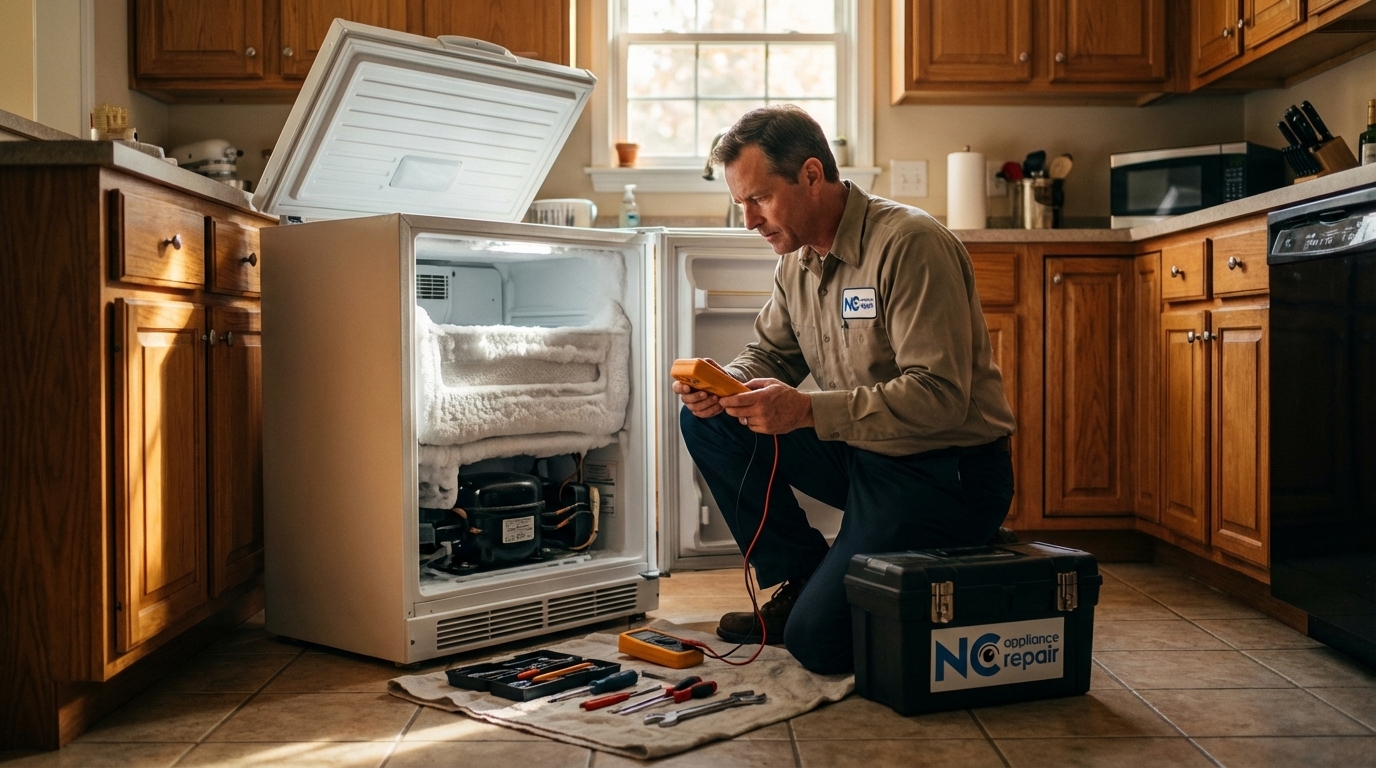
Frost. Everywhere. That's a huge warning sign for your freezer. A bad omen. You might believe a little ice buildup is just a part of owning a freezer, an annoyance to chip away later. But a thick layer of frost often signals a deeper issue with the defrost system or a failing door seal. With a compromised seal, warm, moist air sneaks inside and turns into ice. That constant battle forces the compressor to work overtime. Over a short time, this extra strain can burn out the motor, leading to an expensive repair.
Then there's the opposite problem: the freezer won’t stay cold. Your ice cream is more like soup, and you catch that first hint of a spoiled food smell. The internal temperature just can't seem to drop below freezing, no matter how low you set the thermostat. A hundred different things can cause this, from dirty condenser coils to a failed start relay. Trying to guess the exact culprit is a good way to waste both time and money.
We also get a lot of calls about noises. Hearing that constant buzz, a sudden loud clank, or a weird humming can be quite jarring in a quiet home. These sounds aren't just quirks; they're symptoms of mechanical distress. They often point to failing parts: the compressor, the condenser fan, or the defrost timer. Seeing which part is the source of the noise takes a trained ear. And leaving it alone is a big mistake. A struggling fan motor can turn into a full system failure if not addressed.
Sometimes, the problem is silence. Your freezer just stops working. No hum, no lights, no cold air, nothing. Before you panic, checking the circuit breaker is always the first move.
And don't ignore puddles of water on the floor. That's a classic sign of a defrost drain clog. Ice builds up, melts during the defrost cycle, and then has nowhere to go but out onto your kitchen floor. Over time, that water can damage your flooring and create a nasty, musty odor in the room. A simple cleaning might not be enough; the blockage could be deep inside the drain line. This particular freezer problem almost always needs professional service to resolve for good.
All of these common freezer problems share one thing: their causes are almost never obvious to the untrained eye. What looks like a simple door seal problem could be masking a thermostat malfunction. But trying to replace a part on your own without a correct diagnosis is a huge gamble (and often leads to buying the wrong part). That's why these situations demand a real call for freezer repair services. It saves you the headache. A technician can test the specific components, identify the true source of failure, and offer a precise solution. Because with appliances, the symptom isn't the disease. And fixing the wrong thing never works.
So, you know your freezer is broken, but now you face the big question. Figuring out whether to sink more money into appliance repair or just buy a new one is a tough decision that every homeowner confronts at some point.
A great place to start is the 50% rule: a simple guideline I tell all my clients about. If a repair quote is more than half the cost of a comparable new freezer, it's time to think about replacing what appliance you have. An old machine that needs a major fix isn't a good investment. When a repair cost exceeds $250 for a unit that's near the end of its life, the math just doesn't add up.
Age is a huge piece of this puzzle. With a freezer under five years old, a repair almost always makes sense. But what about a unit that's hitting the 12-year mark? That’s where things get tricky. Newer freezers are way more energy-efficient, and new models can save up to $50 a year on your electric bill. That savings adds up over time, offsetting the purchase price. Plus, once one part fails on an old machine, others tend to follow; it’s a domino effect. The real question is this: what's your peace of mind worth? A new warranty offers security; an old, patched-up appliance offers a constant, low-level worry in the back of your mind. Which constant sound do you want in your home: the quiet, confident hum of a new freezer or the deafening silence that happens right before it breaks again?
Thinking about the repair's nature is just as vital. Certain freezer repair jobs are minor and well worth the expense. For example, replacing a torn door seal to stop frost buildup is a quick, inexpensive fix that makes total sense. A failed compressor, on the other hand, is a different beast altogether. For that kind of work, you’re looking at a huge bill for parts and labor, often making it a clear vote for replacement. Knowing which part has gone bad gives you the power to make an informed choice; get a professional diagnosis before making your move.
Let's not forget the environmental angle. Repairing your freezer keeps a massive object full of metal and chemicals out of the landfill for longer.
When you have all the facts, the choice gets easier. You have the 50% rule as your financial guardrail, the appliance's age as a timeline, and the specific repair's complexity as a practical measure. This isn't just a decision about the money you spend today. It’s about the potential headaches you avoid tomorrow. Sometimes, investing that repair money in a new, efficient unit with a full warranty is the superior long-term strategy for both your wallet and your sanity.
Assuming all freezer repairs are the same is a common homeowner mistake because different units present unique challenges. In reality, the interconnected systems inside a refrigerator-freezer combo present a diagnostic challenge quite distinct from the straightforward mission of a dedicated chest freezer. The repair approaches are different. With shared components, a problem in the fridge section can manifest as a symptom in the freezer. That means a technician needs a specific mindset for each type of machine. This fundamental difference is where a lot of DIY repairs go wrong.
When we get a refrigerator repair service call, we're often hunting down issues that affect both compartments. Think defrost timer failures or faulty damper controls.
Now, standalone units, those deep chest freezers or upright models, are a different story. They have one job: keep everything frozen solid. The components are less complex, and failures are not so ambiguous. When you hear a strange humming sound from a chest freezer, the search for the cause is a much shorter path.
You can't use a one-size-fits-all diagnosis.
Knowing this split is the signature of any expert in top refrigerator repair. A combination unit has a complicated defrost system that most standalone freezers do not have, a system designed to prevent ice buildup. So, a strange clicking sound from a fridge-freezer could just be the defrost timer doing its job. But hear that same clicking from a dedicated chest freezer and it often signals a serious issue: a failing thermostat or relay. Technicians who treat them the same waste your time and money. With a standalone unit, the diagnosis is more direct: it's not cooling or it's making a racket. You must adapt the repair to the machine itself.
By separating these two appliance types in our diagnostic process, we can pinpoint failures with more precision. The repair for a refrigerator is a system-wide investigation. The freezer repair is a targeted strike.
So why wait for your freezer to fail? A little bit of proactive repair and maintenance makes a massive difference for its long-term health. It's that simple.
Checking the condenser coils is a great first step; they are a major part of the cooling process. You'll find them on the back or bottom, often covered in dust and pet hair. When they're dirty, they can't release heat, forcing the compressor to work overtime. Second, run your finger along the door gasket (the rubber seal). A brittle or torn seal is a huge energy waster that lets cold air pour right out of the machine. These two checks alone can prevent so many common problems.
Third, keep a simple thermometer inside your freezer. You want to see it hold steady around 0°F.
For units that aren't frost-free, the fourth task is vital, defrost it when ice builds up a quarter-inch thick. Heavy ice buildup acts like an unwanted blanket, insulating the interior and making the cooling system struggle. Fifth, make sure nothing blocks the interior air vents inside the freezer. Good airflow is non-negotiable for consistent temperatures. Without it, you get warm spots where food can spoil fast.
Number six is something people often forget: make sure the unit is level. An off-balance freezer can cause the door to not seal with a tight fit, plus it puts extra stress on the compressor motor from vibration. And the last piece of advice for maintenance services appliance care is to check the drain pan if your model has one. It can collect some nasty gunk. Keeping these simple things in your routine is a fantastic way to extend your freezer’s life. With a good system, you are taking control of the machine’s wellness.
This kind of freezer repair and maintenance isn't about being an expert. It's about prevention. A few minutes of your time every few months is all it takes. This simple effort will save you from a major headache later on.
A dead freezer. The homeowner thought it was a total loss. Not even close. It was just one hidden component that gave out after years of constant work. Many parts replace repair jobs start just like this; a big problem from a small part. Understanding these critical pieces is the first step in any real diagnosis.
The heart of your freezer is the compressor; it's the engine that pumps refrigerant. When this fails, you often hear a click or a faint hum. A dead compressor is a big deal. For older units, replacing this single part can sometimes cost enough to push you toward buying a new freezer.
And then you have the brains: the thermostat. This part tells the compressor when to turn on and off. A bad one either runs the freezer non-stop or not at all. Just as important is the door gasket, the seal creating the door's airtight fit. With age, it gets brittle, letting warm air sneak in. This leak forces the unit into overdrive and causes ice buildup. Replacing a gasket is a fast fix. But without that perfect seal, your freezer just wastes energy.
We also inspect the fan motors. Inside the freezer, the evaporator fan must circulate cold air. Without proper flow, you get inconsistent cooling.
Smaller parts cause major issues, too. A start relay gives the compressor the kick it needs to begin a cycle; when it fails, the compressor won't run. In frost-free models, the defrost system is another frequent culprit. A failure here leads to solid ice choking the air vents. We service freezer parts like these with expertise because a wrong guess costs you money.
A freezer is a system of interconnected components. That’s why you call a technician: for the right diagnostic tools and field experience. With that combination, we can pinpoint the failure's exact cause. Most are surprised their expensive appliance is down because of a cheap part. We carry a full inventory for just about every job. Our objective is always a first-visit fix. By finding the true failure point, we get your machine running again. It's about a smart, targeted repair.
You might think just grabbing the first result for "repair services near you" is the quick fix when your freezer goes down, but that impulse decision often leads you straight to an overpriced, underqualified stranger who leaves you with the same problem and a lighter wallet.
Start with real, local reviews on platforms like Google Maps or Nextdoor; skip the big national directories that just prioritize paid listings. Genuine feedback from people in your town gives you a true picture of what to expect from an appliance service near you. But don't just glance at the star rating. Dig past the five-star fluff and read the one- and two-star comments for recurring themes about tardiness or surprise charges. A pattern of good comments often mentions specific details: the technician was clean, explained the problem with clarity, or had the exact part needed for a one-visit fix. Knowing these details helps you choose with confidence and prevent that awful metallic taste of freezer-burned food. Plus, check for a legitimate physical address on their website, not just a vague map, as this signals real community ties. By vetting their digital footprint with care, you can sidestep the faceless lead-gen sites that just sell your info to a subcontractor.
With a shortlist of two or three solid candidates, the real screening begins with a phone call. Ask direct questions: are you fully insured and are your technicians certified for my freezer's brand? Any hesitation is a huge red flag that should make you hang up the phone. You also want a concrete breakdown of their service call fee and what that initial charge includes; some apply it toward the repair cost, but others treat it as a separate diagnostic fee. Getting clarity here avoids nasty surprises when you get the final bill. And ask about their warranty on both parts and the labor, a quality repair service will stand behind their work for at least 90 days.
I remember a homeowner who hired a restaurant repair tech for his kitchen freezer. That tech, accustomed to massive walk-in units with high-voltage wiring, misdiagnosed a simple thermostat issue and proposed a total system overhaul. It was a costly, near-fatal mistake. The distinction between residential and commercial appliance services is huge. Commercial units are built for brute force and constant use, think stainless steel beasts in a restaurant kitchen. Residential models, however, are made for quiet operation and energy conservation in a home setting.
They just aren't the same machine.
For a commercial technician, the entire toolkit is different. A commercial freezer often runs on a dedicated 220-volt circuit, while your home freezer plugs into a standard 110-volt outlet. A technician unfamiliar with this can cause serious electrical damage. Their diagnostic tools are calibrated for heavy-duty systems designed to reach extreme temperatures (like -10°F for a restaurant walk-in). Those specialized tools might not even register the subtle performance shifts of a home appliance. They expect power and noise, not the finesse required for your kitchen.
On the flip side, a residential freezer technician stepping into a commercial kitchen would be just as out of place. The scale, the complexity, and the urgency are on another level entirely. He wouldn't carry the right parts for a high-capacity compressor or have the experience with three-phase power systems. With a business, downtime costs real money every minute that ticks by. Commercial repair is all about speed and industrial-grade fixes. Residential service, on the other hand, is about precision and respecting your personal space. Knowing this difference is about more than finding a qualified person; it’s about finding the right expert for your specific world.
But here's the thing about expertise: it isn't just about knowing how a generic freezer works, it's about understanding the unique personality of a GE Artica that refuses to defrost, the specific fan motor a Whirlpool side-by-side uses, and the delicate electronics inside a modern Samsung Family Hub refrigerator's freezer compartment. We know them all, inside and out. Every single model. From our experience, these subtle differences are what separate a quick, successful fix from a frustrating string of return visits. Without that deep knowledge of what makes each brand tick, a technician is just guessing with your money. Knowing which compressor relay Kenmore preferred in 2015 can save hours of diagnostic work. We’ve seen firsthand how a simple door gasket issue on a Frigidaire looks different from the same problem on a Bosch. You benefit from this brand-specific experience with a faster service call and a machine repair that actually holds up.
Our service umbrella covers just about every residential freezer you can imagine.
And it's not just the common names that you service. Sure, we have handled thousands of Maytag and Amana units, but our technical skills extend to higher-end appliances too. Think of names like Sub-Zero and Thermador, where the engineering is complex and the parts are anything but standard. For a tech to be effective with these machines, a deep parts catalog knowledge is a must. Seeing the distinct compressor mounting on a Viking versus the setup in a KitchenAid reveals two different worlds of appliance design. This familiarity allows for a swift diagnosis and precise repair, no matter what label is on the front of your appliance door. We're prepared for the specific challenges each brand presents (like LG’s well-known compressor issues), so your problem doesn't become our puzzle.
In our trucks, a well-organized stock of components for all major brands is a source of pride. You can see the neat, manufacturer-branded boxes ready to go. By stocking the most common failure parts, we eliminate the frustrating delay of waiting for a shipment. This means the defrost timer for your GE or the evaporator fan motor for that noisy Whirlpool is often on hand for an immediate fix.
The brand of appliance in your kitchen does not matter to our technicians. A decades-old chest freezer making a strange sound or a new upright with a faulty ice maker. We’ve worked on both with success. Our goal is simple: a solid repair that extends the life of your machine. With our experience across so many brands, we bring a level of confidence to the job that is hard to find. We have seen all the tricks and quirks they hide. You get peace of mind, and your freezer gets back to work.
However, you might wonder if that quiet hum turning into a loud buzz is enough to justify a service call. That strange new noise is often the first warning of a failing evaporator fan or a struggling compressor, a serious problem that puts all your frozen food at risk. Ignoring that sound is a mistake.
Thinking about the potential cost is what stops most people from picking up the phone for a freezer repair. A simple diagnostic service and a quick fix like a thermostat replacement have a predictable price point. But something more involved, like addressing a refrigerant leak or replacing a sealed system component, requires more labor and specialized parts. Questions about part warranties and what that coverage means for your out-of-pocket expense also come up quite often. With genuine manufacturer parts (the only kind we trust), you get peace of mind knowing the component is built to last. Our repair service comes with its own guarantee on labor, ensuring the job is done right without repeated visits.
Another frequent question is what you should do before the residential freezer technician arrives at your home. For us, clear access to the appliance is the most important preparation; moving boxes or other clutter makes our work faster. Having the model number handy helps too.
Professional repair and service save you guesswork, money, and a freezer full of lost food.