You might think that little clicking sound is just a harmless quirk you can learn to live with, a minor nuisance in your daily routine, but what happens when it’s the first real sign of a deeper problem developing inside your appliance? These signals are serious. Don't just dismiss them. An uneven, weak flame. A burner that refuses to heat up. That weird, faint plastic smell after a few minutes of use. These are not personality traits of your machine. They are clear warnings; your cooktop has problems.
Ignoring these signs often leads to bigger headaches; sometimes the outcome is even dangerous. A small repair need can snowball into a major component failure. Knowing the difference between a simple issue and a true problem is the first step.
Your type of cooktop sends its own special signals. Gas models have specific flame and igniter issues. Electric coil and smooth glass tops show their faults through heating failures. Induction cooktops have unique quirks, like refusing to recognize your pans. With some basic knowledge, you can start to spot these cooktop repair needs. Understanding what you are seeing is a huge advantage.
Listen to your kitchen.
These early alerts won't fix themselves. By addressing potential issues now, you save a lot of stress. And that's a much better way to manage your home.
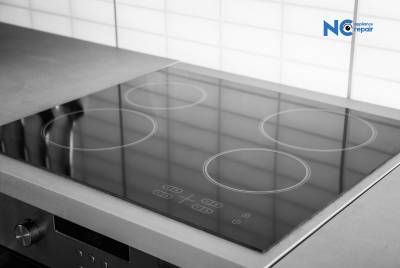
Not all cooktops fail alike. Your cooktop's type dictates its specific problems. A huge difference. Knowing the technology inside is the first step toward any successful cooktop repair.
Here's the thing about diagnosing common cooktop problems: the sound often tells you the whole story before you even lift a finger. That maddening, endless click-click-click from a gas burner that absolutely refuses to light is a classic symptom. It’s an unmistakable auditory clue pointing to trouble. By listening close, you can often pinpoint the issue: maybe a dirty igniter electrode covered in baked-on grease or a burner cap that got knocked just a millimeter out of alignment during cleaning. An electric coil or glass top offers a different kind of audio clue, the unnerving and total silence where there should be the quiet, steady hiss of a heating element glowing red-hot. That silence signals a dead element, a faulty infinite switch, or a break in the wiring. With modern induction cooktops, the issues get even more technical, revealing themselves as a strange, high-pitched buzz when a pan is placed on the surface or a repetitive beep because the unit's sensors completely fail to detect your expensive cookware. Repairing a cooktop begins with decoding these distinct failure modes, the clues are right there if you know what to listen for.
So, your troubleshooting method has to be just as specific. You can’t attack an electronic control board issue on an induction unit with the same tools you'd use for a clogged gas jet.
Thinking about the right fix means you must first identify the right problem for your specific appliance type, as there is no single solution for all models. We're about to get into the details for each distinct system, breaking down precisely what those symptoms really mean for your kitchen. This is how you confidently move from just hearing a strange noise to actually understanding the internal mechanics, which is the whole point of effective troubleshooting. Knowing the unique quirks and common failure points of each system empowers you as a homeowner: you'll learn to spot the telltale patterns of weak, yellow gas flames, recognize when an electric coil's thermal limiter has given up, and decipher the confusing error codes blinking on an induction display. Getting this diagnostic part right is the absolute key to making an informed, cost-effective decision, helping you figure out if you're facing a simple ten-minute fix or a complex cooktop repair that demands a professional's specialized tools and experience.
On the other hand, a huge point of confusion I see that stalls out so many service calls is when people use 'stove' and 'cooktop' without a second thought, assuming they're the same when a technician visualizes two different mechanical universes, one a self-contained unit in a counter, the other a massive appliance with an oven, which dictates the tools, parts, and time needed. This simple language mix-up creates roadblocks. Costly ones. And it's a disconnect that turns a straightforward oven repair into a frustrating, multi-day ordeal.
Understanding the distinct anatomy of each appliance is the key to getting efficient help when you need it. Let's be precise: a 'cooktop' is just that top surface with burners or elements, an independent piece of equipment that is installed into a cutout in your countertop. It has its own connections and operates with total independence from the oven, which keeps any troubleshooting contained just to that one unit. But a 'range' is the whole show, the all-in-one appliance (what many people call a stove) that has the cooktop on top and a full-size oven underneath, all housed in one freestanding metal box. These two functions are often intertwined, sharing control boards and power sources. With a range repair, a technician might discover a bad oven sensor is disrupting the cooktop display, a complex, interconnected problem you’d never find on a standalone unit. It’s a difference that prevents you from tasting that awful, metallic hint of an electrical short in your next meal because a shared component failed.
So how does this inside baseball about appliance names save you from a headache? Using the correct term, 'range repair' for your combo or 'cooktop repair' for the countertop model. You give the service company the critical intel they need to schedule enough time and load the right parts onto the truck. Fixing a residential range stove can involve pulling the unit out from the wall to get behind it, a much bigger job than lifting a cooktop from its granite perch, a difference that directly impacts your quote and prevents surprises. This isn't about being picky with words; it's about setting up the repair for success from the very first moment you ask for help.
Knowing the name is just the start. The real dilemma is deciding if a repair makes sense for your budget on your specific cooktop. A tough gamble. For me, the guide is the 50% rule: when a single repair quote creeps over half the price of a comparable new model, you should pause and reconsider. And that's a calculation best made with a clear head, not while the unsettling, sharp smell of ozone from a fried control board hangs in your kitchen air.
An appliance’s age is a huge factor in this choice; that expensive gas cooktop might have a 15-year lifespan, but a basic electric model is often finished after just 13 years. By sinking a few hundred dollars into a machine that's past its prime, you are almost certain to face another failure soon. It becomes a cycle of constant, small repairs that add up with speed.
The type of repair makes all the difference. Seeing the repair estimate in black and white clarifies a lot of the ambiguity. I’ve seen two common situations: replacing a faulty igniter or a burner element for around $150 on a five-year-old cooktop is an easy yes, but fixing a cracked glass surface often costs upwards of $500. For an old machine, that kind of major component failure is a clear signal to start shopping. A dead control board can be just as expensive, and it's another repair that just isn't worth the investment on a unit approaching its ten-year mark. When you're facing those major costs, your money is, in most cases, better put toward a modern appliance that comes with a fresh warranty and zero past issues.
You might think a quick DIY cooktop repair is smart. Knowing where to draw the line between a simple fix and a real danger is vital.
So what can you handle with confidence? Deep cleaning is a solid first step; scrubbed grates and clear gas ports improve flame performance. Visually inspecting the igniter for food and seeing it clean can solve endless clicking. Before you panic, check your home's circuit breaker. For induction models, just confirm your cookware is magnetic to fix a detection headache. These tasks are low-risk because they don't require taking the appliance apart; that's the key.
Once you grab tools to open the unit’s housing, you’ve entered dangerous territory. Without training, touching internal electrical parts can lead to high-voltage shock. And messing with a gas line invites a risk you cannot afford to take. The potential consequences of an error are just too severe to gamble on.
Certain problems demand a professional without exception: a cracked glass surface, a fried control board, or a dead heating element. These are complex repairs requiring diagnostic skill and the right parts. With a gas cooktop, any work involving the gas valve or supply line is for a technician. Don't do it. An expert understands the precise calibration needed for safe operation. Professional service also comes with a warranty on the labor and the part. Calling a pro ensures the repair is done with precision and safety for your home.
What happens when you pick the wrong company? A costly mistake. I've seen it happen to homeowners. And it’s awful. One person I know hired a cheap technician without credentials, a decision that nearly ended in disaster. The supposed cooktop repair not only failed in days but also created a new gas leak because the connection was not set with precision. By searching for a few non-negotiable qualifications, you can select a genuine expert from the long list of providers. This vetting process saves you from that awful, bitter taste of being taken for a ride.
First, you must always verify their credentials; this means looking for active licensing and full liability insurance for any potential damages. Without that protection, any accident in your kitchen becomes your financial burden to handle.
With their credentials confirmed, you move on to the warranty, the single most important detail separating real professionals from quick-buck artists. A real warranty is not just a promise; it is a written guarantee that covers both the specific parts installed and the labor itself for a definite period. In my experience, you should never settle for less than a 90-day guarantee, as it shows the company is confident in its repair skills and the quality of their components. Asking for these terms in writing before you agree to the work prevents future arguments and gives you solid ground to stand on if the problem returns.
Demand a detailed, itemized quote before any work starts, ensuring you approve every charge from the service call to the final cost of labor.
And speaking of cost, look for service professionals with transparent, upfront pricing to avoid nasty surprises on the final bill. A good technician will explain their diagnostic fee; they should also confirm if that amount is applied toward the total repair cost if you approve the job. After the diagnosis, they must give you a complete estimate to approve. This step is a standard for any reputable business. When you are doing research, read online reviews from several different sources. Ignore the lone five-star and one-star outliers and instead look for consistent themes across many customer experiences. And finally, trust your gut. If the person on the phone seems rushed or dismissive of your questions, that is often a sign of the poor service you can expect from them in your home.
Bad service is terrible. Unlike the horror stories you hear from friends, a good appliance service call should be simple and stress-free. It should leave you with the sour taste of a ruined dinner plan washed away by relief.
The whole process starts with your first contact. A professional on the phone will gather details and give you a clear appointment window (not an entire day). On the day of the visit, the technician gives you a heads-up call when they are on their way. An expert shows up in a marked vehicle, wearing a uniform and carrying identification. First impressions are a big deal, and so is protecting your home; they’ll put down mats or wear shoe covers without you asking.
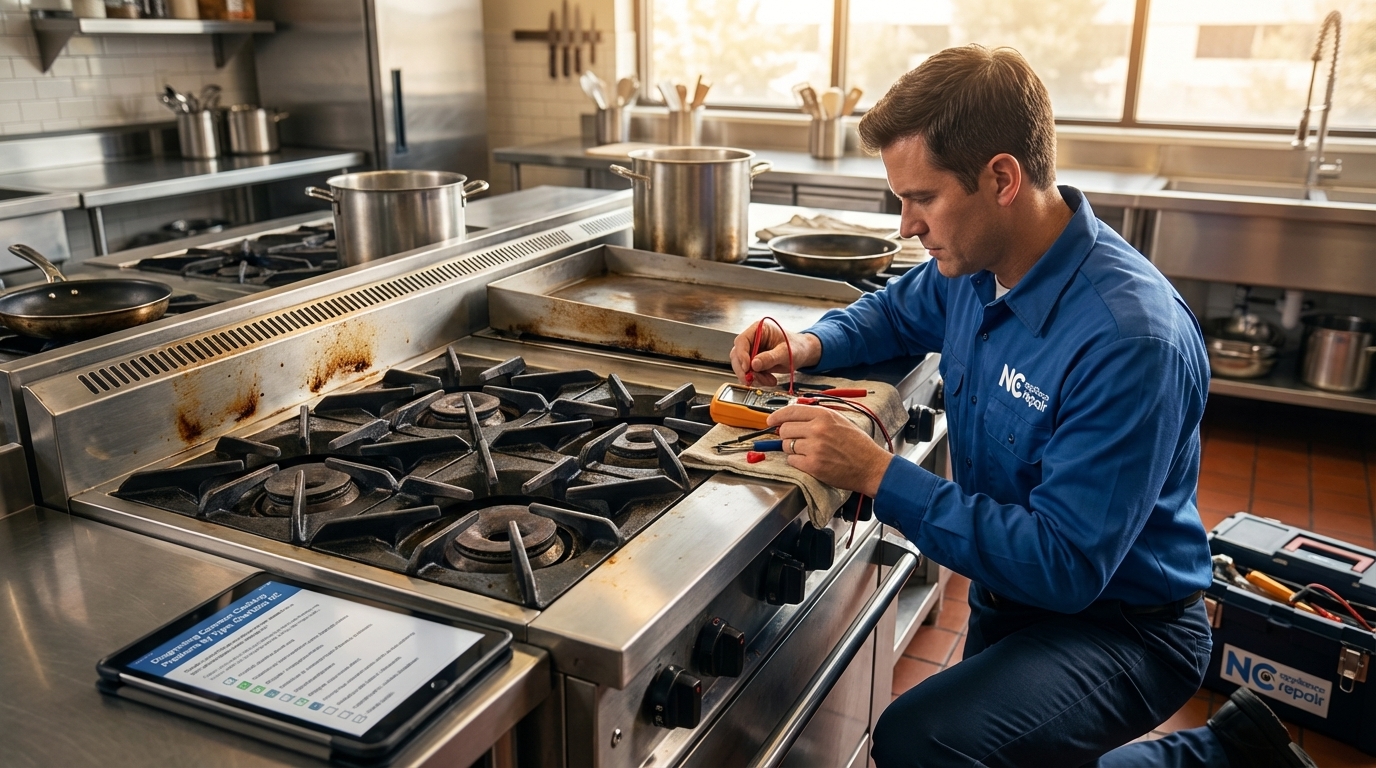
Then comes the actual diagnostic work. A good technician is part detective, so they’ll ask you what happened and listen to your description of the cooktop problems. With that information, they begin a systematic inspection. It's not guesswork. In my experience, a full diagnosis takes around 30 minutes for most common cooktop issues. They'll use proper tools, like a multimeter, to test electrical components. After pinpointing the source of the problem, the tech explains the situation in plain English. You'll get a clear, itemized quote that breaks down the cost: the price for the parts and the charge for the labor. This is your moment to decide; you can approve the repair or just pay the diagnostic fee for their time.
With your approval, the actual cooktop repair work starts. Many technicians have vans stocked with the most common parts, meaning they can often fix it in one visit. Knowing that over 80% of gas cooktop problems come from a bad igniter helps them prepare. A typical igniter module replacement, for example, is a fix that costs around $185 parts and labor included. If they do need to order a specific part, they book the follow-up appointment right then and there. Throughout the repair, a real professional works with precision and keeps their work area contained.
Once the new component is installed, the job isn’t quite finished. They test all the burners and functions of your cooktop. It’s their way of making sure the original problem is gone and no new ones have appeared.
The final step is the walkthrough and payment. A great technician will show you what they did and might even offer to show you the old broken part. Processing payment is the last action item on their list. From them, you should receive a detailed digital or paper invoice outlining all charges. And that receipt should include warranty information on both the parts and their labor, giving you total peace of mind.
You might think a commercial cooktop is just a bigger version of your home appliance with a few extra burners, something that gets constant use but is built from the same basic parts, yet the reality is that it’s an absolute workhorse operating in a brutal environment. Downtime here isn't an inconvenience.
It's a business killer. Think about the insane demands of a restaurant kitchen compared to your home. That cooktop runs for hours on end, day after day, under intense heat and stress. Pans slam down on the grates, grease builds up in places you can't even see, and the wear is just constant. By choosing to ignore small problems, you risk a total shutdown during the dinner rush. We're not talking about ordering a pizza; we're talking about lost revenue and angry customers. These machines are the heart of your operation.
Repair needs for a business are emergencies. There's no waiting for a service window next Tuesday.
That's why our approach is different. With commercial appliance repairs, the technician needs specific experience with heavy-duty brands like Wolf or Vulcan. They also understand the stakes are higher. Safety inspections are far more rigorous, everything gets a closer look.
A true professional gets this.
What you get is a different level of response. This means priority scheduling (sometimes same-day service is available) and a technician who shows up prepared for war. And they arrive stocked with the right parts for high-failure commercial components, because time is everything. A residential fix for an igniter that costs a homeowner $185 might cost your restaurant thousands in lost business. Thinking ahead with preventative maintenance plans is just smart business. These plans help avoid catastrophic failures. In a hot kitchen, you can feel the wave of intense heat from a bank of six roaring burners, a real reminder that each one is a vital tool for your success.
But what if you didn’t have to make that frantic call? Think ahead. You can dodge that frustrating repair call. It's true. Most common cooktop problems I see start from a place of simple neglect, not some sudden catastrophic failure, and a little bit of mindful use is your best defense, a strategy that extends the life of your machine and keeps your money where it belongs (in your wallet).
The golden rule is simple: clean spills as they happen, because a sticky mess today becomes a permanent, carbonized scar tomorrow.
Checking the type of damage your specific cooktop is vulnerable to is half the battle for services appliance wellness. A glass or ceramic surface, for example, has a mortal enemy, sugar. That sugary boil-over from making caramel or jam isn't just sticky; if you let it cool and harden on a hot surface, its chemical structure can bond with the glass itself, creating permanent microscopic pits you can never scrub away. You have to address that with speed, using a proper scraper while it’s still warm. With a gas cooktop, the problem is more mechanical, where food debris from a bubbling sauce clogs the tiny burner ports and blocks the flow of gas. This is precisely why you hear that pathetic, sputtering orange flame instead of the confident, clean blue hiss of a burner working at peak performance. An old toothbrush or even a straightened paperclip can clear these ports out in a pinch (with the gas off, of course). And don’t forget your cookware; that beautiful, heavy cast-iron pan is a kitchen workhorse, but its rough bottom will scratch a smooth glass surface without mercy. Always lift it, don't slide it. Your pots should also have perfectly flat bottoms to sit flush on the element, ensuring even heating and preventing the kind of hot spots that can warp pans and burn out electric coils over time.
Treat your cooktop with respect, and it will give you years of service without complaint.
But here's the thing about cooktop repair services. People always want to know the final cost right over the phone. Tough call. A simple igniter replacement on a common GE gas cooktop might run you under two hundred dollars, but a cracked glass top on a high-end induction unit could be near a thousand. The specific brand and the part needed makes a massive difference.
What about brand names? In my experience, parts for brands like Wolf or Viking cost more, while Whirlpool or Frigidaire parts are easier to source and less of a hit to the wallet.
Another big question I get: how long does a repair take? For a standard issue, a skilled tech can diagnose and fix it within an hour or two. Of course, that assumes they have the part on the truck. If a specific control board or a rare heating element has to be ordered, you might wait a few days. With that kind of delay, some people start thinking about replacement. Patience can save you hundreds over buying a whole new appliance.
And what if the cooktop is just… old? Knowing when to pull the plug is hard. There's a general guideline some of us use (the 50% rule). If any single repair costs more than half the price of a comparable new cooktop, it’s time to start shopping. By that logic, you avoid sinking good money into a failing machine. Thinking about the age of the appliance is also smart. An eight-year-old cooktop with a minor problem is a good candidate for a fix. A fifteen-year-old model with its second major failure is telling you it's time to retire..